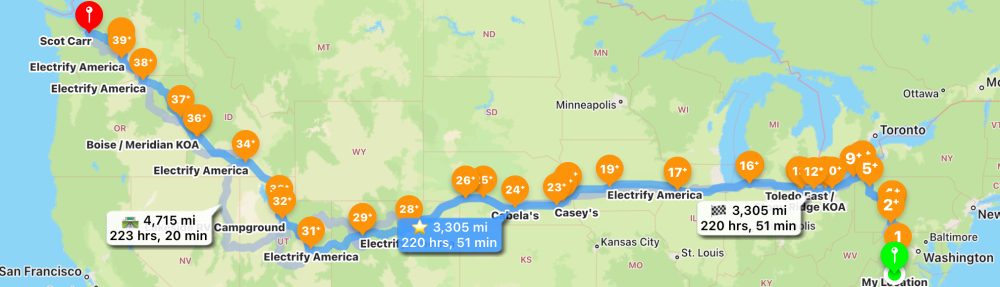
Well, more a semi-boondoggle day. It started with us getting lost just north of San Francisco. A GPS has an unusual mindset sometimes, and that morning ours firmly believed that side streets with speed bumps were a more direct route north than I-80. Our destination was Lassen Volcanic National Park. But once we successfully found I-80 we failed to take a right turn where we needed to and were on the wrong road, then discovered our error, retraced our steps only to learn that the right road was closed 47 miles ahead (just a few miles before the park), so the wrong road we’d taken was actually the right road. All this added a good hour to our trip.
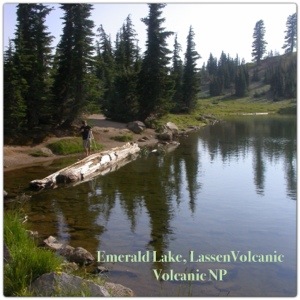
We finally arrived at Lassen Volcanic around 4pm, and it turned out to be a lovely time to drive the tour road through the park. The park was fairly empty, and the light was good for photographing the peak and the surrounding lakes. Lassen Volcanic is still an active volcano, as it’s been less than 100 years since it erupted. The road, another masterwork of switchbacks to rival Rocky Mountain, climbs through the park to reach 8,512 feet and then slowly descends to about 6,000 feet at Lake Manzanita where we camped. We especially enjoyed a stop at Emerald Lake, a glacial lake that was isolated when the glacier receded. Algae at the bottom of the lake give it a deep greenish-blue color. The lake was stocked with rainbow trout many years ago which they are trying to remove, as they feed on the tadpoles of a rare native species of frog.



You can’t travel anywhere in the West without being faced with man’s intervention with nature in the form of dammed rivers, mining operations, land-clearing for crops or asphalt parking lots for large shopping centers, or air filled with smoke from man-made forest fires or factories. In some cases, it is arguably progress. But when you visit the national and state parks and see their pleas to save the bears, the trees, the frogs, to not interfere with the wild animals or the land that holds precious fossils, or to protect the rivers and their inhabitants, you have to wonder at what we’ve already done to this Earth and what the real long term effects will be. It’s chilling to look at a place like Yosemite and realize that there were once powerful men who only saw it as a rich resource of raw materials for industry or commerce. Fortunately it has been preserved for us by the federal government, but how much else of our incredible country is at risk? How much can we afford to sacrifice to progress?
 On the Road Again