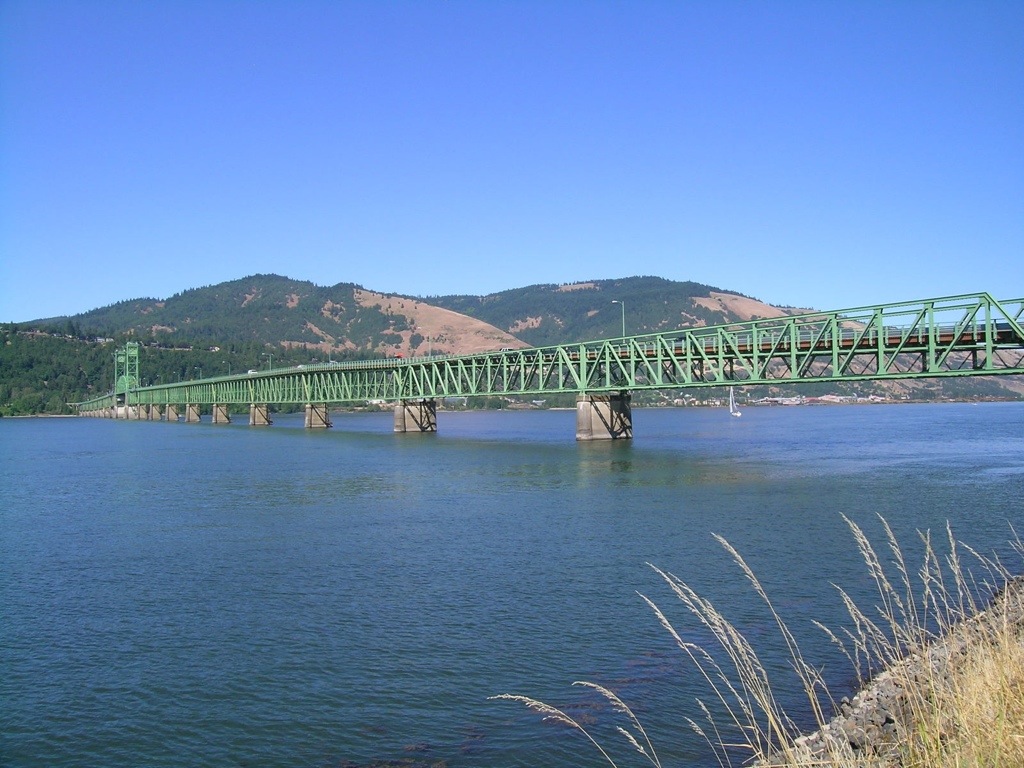
As we crossed over the Hood River Bridge into Washington, it reminded me of the first time I did it in 1996 on the backseat of a motorcycle. I captured that event in the following short essay.
Finding Religion on the Road
It was a brilliant Sunday morning in August, and we were heading north to Seattle on Route 141, looking forward to a stop at Mt. St. Helen’s along the way. We’d camped out along the Columbia River the night before at The Dalles and had just breakfasted at a motorcyclist’s diner in Hood River before crossing the bridge over the Columbia River Gorge into Washington. The strong breeze we’d felt wandering up and down State Street in Hood River looking for a restaurant should have given me some inkling of what we were about to face, as well as the myriad number of wind-surfing shops. But I was naively comfortable with the many bridges I’d conquered in my short motorcycling career and no longer feared anything.
“You know, gusts can reach up to 30 mph in the Gorge,” my husband mentioned casually as we donned our helmets in the diner parking lot.
“Really?” Just like I’d learned how to lean into the curve, I’d learned to keep my body straight with his, so I figured I’d have any challenges to our upright position nailed if I just stayed in line with him.
“Not so bad by itself,” he continued, “but it’s a narrow, old bridge and the road is an open metal grate. It’s a challenge because the grooves of the grating and the treads of the tires never seem to get in line together, and I’ve got to fight to keep the bike going straight. We’ll have to take it slow, but we can’t go too slow either, or it’s even harder to control. Just sit as still as you can.” That was easy; by then I was frozen, my hard-won courage having deserted me.
The bridge itself looked innocuous. It was flat and relatively short compared to some of the monster structures we’d already tackled together. Parked at the traffic light before we began our crossing, the sound of the churning river ahead and the blustery wind were like an awesome, dissonant symphony. As we took off, a stunning scene unfolded before us as we entered the panorama of the Columbia River Gorge. I forgot all my intentions to keep my eyes shut at the spectacular sight of the Columbia River on a Sunday morning filled with hundreds of multi-colored windsurfers collected there to grab the best wind of the day. Brilliant-hued sails peppered the water, all heading swiftly in the same direction like a flock of low-flying, migrating geese. It was a spectacular regatta of every color in the rainbow, as if the river had come alive with jumping tropical fish. For a few seconds I forgot any angst over our unstable road beneath.
Then I heard a loud hiss through the intercom, and I knew it was my husband sucking in his breath, never a good sign. I sensed the wheels’ attempts to fishtail on the grating as their treads sought an elusive, comfortable groove, and I felt his muscles tighten as he controlled the hundreds of pounds of metal between our legs. By this time I was holding onto him like a bloodsucker.
“It’s better if you don’t look through the grates,” had been his last words of advice while we sat at the light, and of course the moment I remembered that, my eyes flew downward. Through the holes in the grating, the sails of the windsurfers looked like colorful specs on the roiling water below. Reality sank in. We were less than a hundred feet above a raging river that could carry us out to sea in minutes or, at its whimsy, dash us into the huge rocks on the shore, and all we had to keep us from tumbling into it was a relatively thin sheet of metal mesh that was doing its best to confuse the tires beneath us.
This called for reinforcements. It was Sunday morning after all, so I began to pray, reciting every prayer I’d ever learned as a child, some several times over before we reached the other side. It gave me an unusual sense of comfort, and I wondered why I hadn’t tried this before. With my newfound source of courage, I even grabbed another glance through the grating.
Sometimes life seems to smack you in the face with a brick saying this is a once-in-a-lifetime experience—relish it! I did. And as we wandered up the north side of the Columbia River after our treacherous crossing, passing the hundreds of cars parked along the edge of the road carrying the gear of all the windsurfers, I realized that I’d experienced something that, for me at least, was nearly as reckless as the brave wind-borne souls taking their chances in the river below. And survived. Life doesn’t get better than that.




 On the Road Again