
No, I don’t mean Billy the Kid, a/k/a William H. Bonney, I mean the Museum’s originator, Ed Sweet. To be blunt, Billy the Kid was a murderer who killed 8 men in the course of his criminal career. He was found guilty twice, sentenced to be executed twice and escaped twice. All before the age of 21 when he himself was gunned down. Not a person I’d want walking the streets of my town. But he was brash, young, notorious and somewhat attractive to the ladies and became the stuff of legends. Several imposters came forward claiming they’d survived; why they’d want to do that when he was a condemned felon with execution awaiting him I’ll never understand. His gravestone was stolen twice (and disappeared for 25 years), and a hundred years after his death he was considered for pardon by the current governor (which was denied.) Movies were made about him, ballads composed. He’s had his moment.

Ed Sweet’s son Don, who has carried on the legacy of his father.
In my opinion, Ed Sweet is the person who made a major difference in the town of Fort Sumter, and his legacy continues long since his death in 1974. Ed Sweet was an avid and open-minded collector of any antique items with a western heritage. After collecting several thousand such items, he and his wife decided to open a small museum to display them. As Billy the Kid had a history with town, they named it The Billy the Kid Museum. The museum now contains at least 60,000 items.
The actual artifacts connected to the Kid are fairly limited, the most notable being the rifle he owned, shown below.

There are dozens of newspaper articles of the era and many Wanted posters. For such a brief life he created a great deal of newsprint.

And of course, there is Billy the Kid’s grave site, located a few miles east of town near the site of Fort Sumter.


Aside from the nominal tip of the hat to Billy the Kid, what impressed me most of Ed Sweet’s legacy is that he brought together artifacts that capture the essence of a time and that easily could have ended up in dusty attics or been thrown in the trash by younger generations, and instead he made sense of them in the context of the history of Fort Sumner. The fort itself was short-lived and a failed attempt by the federal government to control the local Native Americans. But a town grew from these efforts and that museum captures the history of the homes, the local businesses, and, yes, all the criminal activity in a relatively lawless town. It’s a real step back into the Old West.

This is cattle country
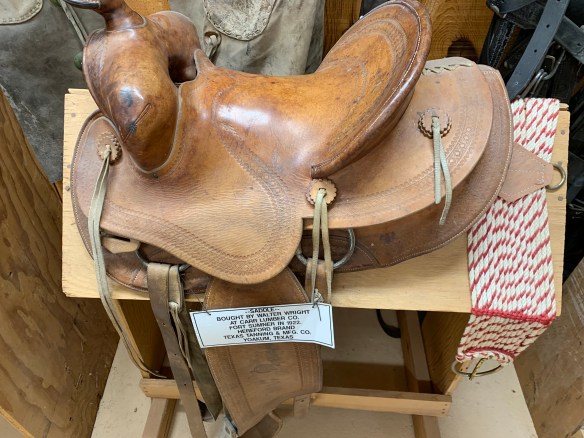
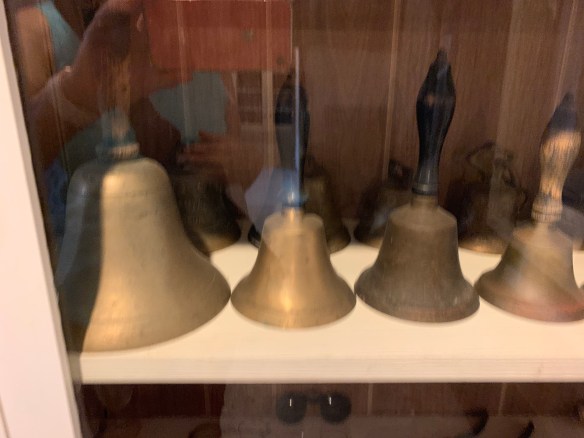

Spurs

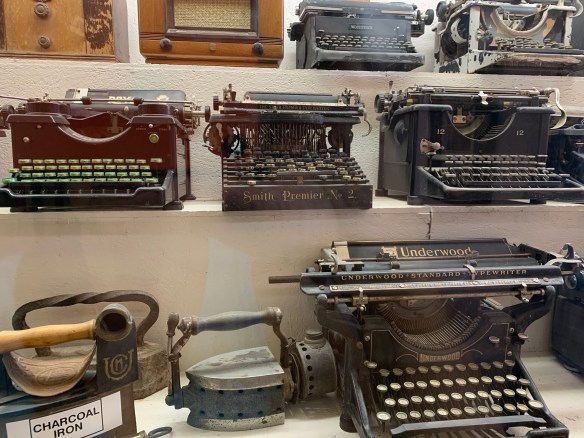
Typewriters and irons

Types of barbed wire

Just a small selection of the many arrow heads found near Fort Sumter
In our many travels, we’ve passed through a few towns where one person or one committee made the affirmative decision to honor its history by gathering from people’s homes, barns or attics those items that capture their town’s history and the people who settled it. These places are special and feel very alive, even if they might be as dusty and worn down by age as the other towns that are on a slow path to becoming a ghost town. Fort Sumner is one of those special ones, primarily because of the efforts of a man like Ed Sweet and his family. Our visit alone left about $100 in the community. In the short time we were there about 30 other people were touring the museum and buying things in a very lovely gift shop. I’m certain the museum is doing much to keep the town’s economy alive. Good job, Ed!
 On the Road Again
Wow! This a great find. We lived in New Mexico for 10 years but never visited Fort Sumter. Thank so much for sharing
Joe
>