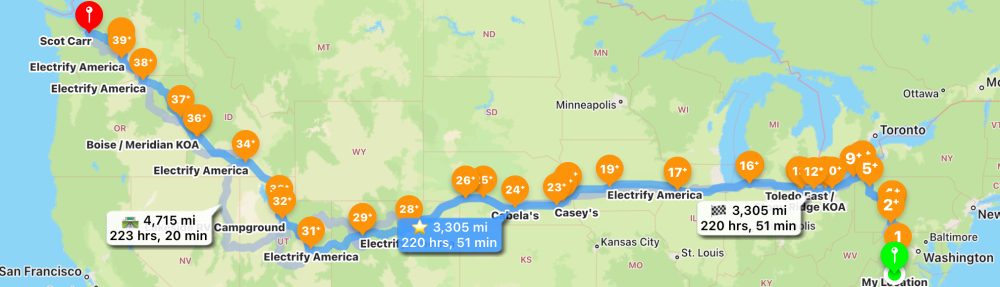
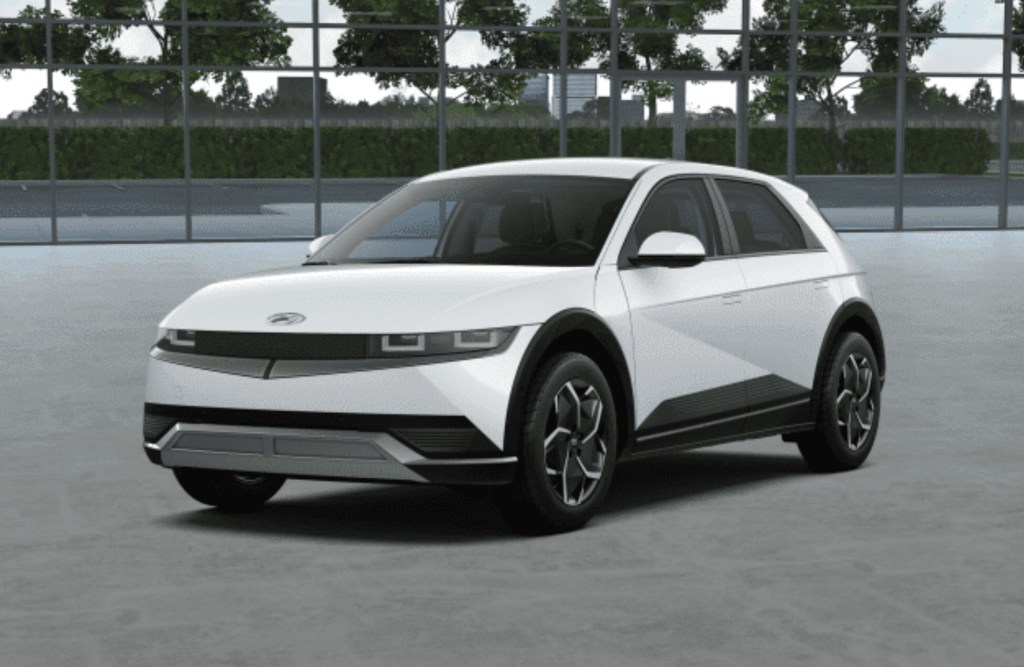
Accomplishing a cross-country trip with his new electric car, a Hyundai Ioniq 5, was a challenge Roger took on with relish. Many people have asked us along the way of our recent travels what it’s like. We’ve met several drivers who own the same car (well, maybe different color), and we’ve had some great conversations with them, which have always ended with an agreement that everyone enjoys their new car. But for many, taking an electric car on a long trip raises a lot of questions and concerns. So here’s the answer to some of those.
First, you need to have a charging station, and they don’t grow on every city corner the way gas stations do. Because we have a two years of free charging from Electrify America, those are the chargers we aim for, and they look like this:

Generally there are four chargers, but sometimes there are more, and they’re usually situated around Walmarts or mall shopping centers, although they’re increasingly showing up at many diverse locations. So, unlike going to a gas station, there is always some uncertainty about whether there will be a charging station available to use when you want to use it. And if they are all unavailable, you either wait in line or go to find another charger. This is not as easy as finding another gas station. Even large cities may have only one charging station available.
That said, in all our travels thus far, we have only once found ourselves in a situation where there was no charger available in the near future and we were forced to move on to another. Fortunately, we were traveling on the East Coast, where it’s relatively easy to find one nearby.
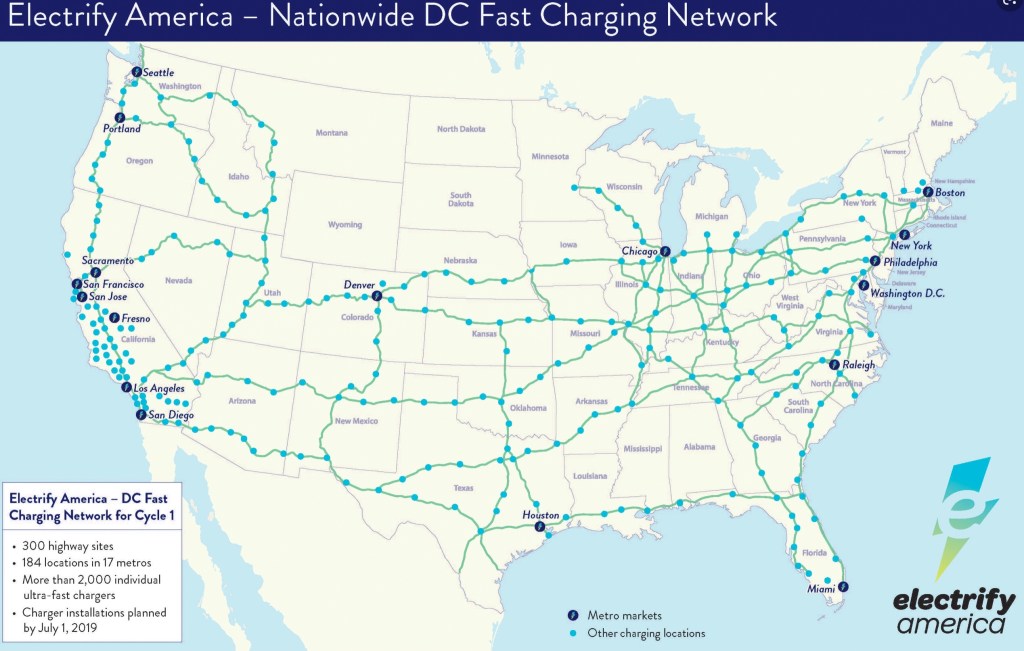
and Possible Cross-Country Routes.
Which leads to the next concern, which is how do you get across the United States being dependent on the availability of charging stations? Well, from the map above, it’s clear that you’d better steer clear of the Dakotas, Montana, and Wyoming, and even West Virginia might be chancy. We’re optimistic that in time, hopefully by next year, this will not be a problem, but for our travels on this trip, while following I-80 much of the way, we needed to swing down down towards Denver, and we’re now working our way back up in a northwesterly direction towards Seattle. It’s all beautiful country, so this is really no problem.
On that point, we did have a bit of trepidation as we grew close to our crossing the Rocky Mountains, which we did through I-70 at the Loveland Pass, as we had not yet tested the Hyundai on any mountains higher than Rockfish Gap near Charlottesville (about 1850 ft.) Our fears were unfounded, as we discovered the regen capability of the electric motor (which puts electricity back into the battery) gave us plenty of extended battery life.
The other main difference with traveling in an electric car is that, unlike the kind of “hit and run” you do at a gas station, i.e., grab your gas and go, it’s a more leisurely endeavor. For my purposes, it’s a welcome break when I can get either some shopping accomplished, or some computer work done, while we wait generally no more than 30 minutes for the car to charge. After that, we’re free for another 230 miles or so, at which time we’re ready for a break anyway. So I find that part of the entire process quite enjoyable.
And there’s nothing like knowing that, for the next two years at least, our car travel costs are minimal. With today’s high fuel prices, it’s making this cross-country trip that would normally cost over a thousand dollars in fuel, very affordable.
One more thing — the car is a joy to drive! It’s solid on the road, has a very smooth run, has an incredible amount of safety features, and has plenty of power when needed. For us, it’s a winner.
 On the Road Again
Carol, as usual, I am so enjoying your travel
posts. I feel like I am in the back seat with you! You are better than George Perot !😃
Carol, I enjoyed your blog. Have been considering electric cars but to date not willing to give up flexibility. Other non-electric states are MS, AL and ME. Electric states seem to be only near interstates.
You’re right, Phil. As long as we stay within striking range of an interstate, we can be assured of a charging station. But with a range of approximately 230 miles/full charge, we still have a lot of leeway to take smaller and often more interesting routes. That said, I-70 and I-80 in the west have truly spectacular scenery that we’ve enjoyed this trip.
Timely that you are covering this topic with Flying J truck stops, Pilot truck stops and GM announcing yesterday they were looking to put chargers every 50 miles across major areas of the USA for around 2000 additional locations by 2025 in highly traveled areas. Safe travels.