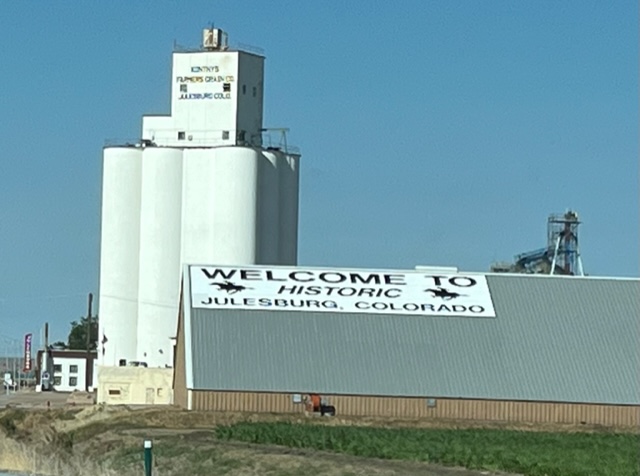
Towns are generally named after admirable citizens who’ve made a major contribution to the founding or the economic or political development of a community. Not so with Julesburg, a sleepy little town in Colorado, close to the Nebraska border. The grain elevator (above) is the tallest building in town.
The original trading post was named for Jules Beni, who was on the Pony Express route from Missouri to California. How he got the town named after him is a mystery when one considers his history. Because the Pony Express required a LOT of horses, with a fresh horse being provided a rider every ten miles, it was ripe for horse thieving, and Jules Beni was one of them. When one of the superintendents for the Central overland California and Pikes Peak Express Company, Jack Slade, came looking for him, Beni shot him five times. Thinking he was dead, the townsfolk chased Beni out of Julesburg, but when they returned they discovered Slade had miraculously recovered. This didn’t stop Beni’s horse thievery, and Slade made it personal, vowing to hunt him down. When he finally captured Beni, Slade took justice into his own hands and, in a rather spectacular manner, made certain that Beni was very dead by the time he was finished. It’s the sort of story of the old west that provided content for movies and TV series in the 1950’s.
Apparently there was no move to change the name of the town to a more respectable citizen, or perhaps they were too busy farming.
A note about grain elevators: it has always intrigued me that some grain elevators (and I’ve seen hundreds over the course of 25 years of travel in the west) have what appears to be a box on the top. City girl that I am, I’ve always thought it served as an office space for the people running the grain elevator. Not so. It apparently contains some of the mechanics required to run the grain elevator in a space called the headhouse. See the diagram below.

 On the Road Again