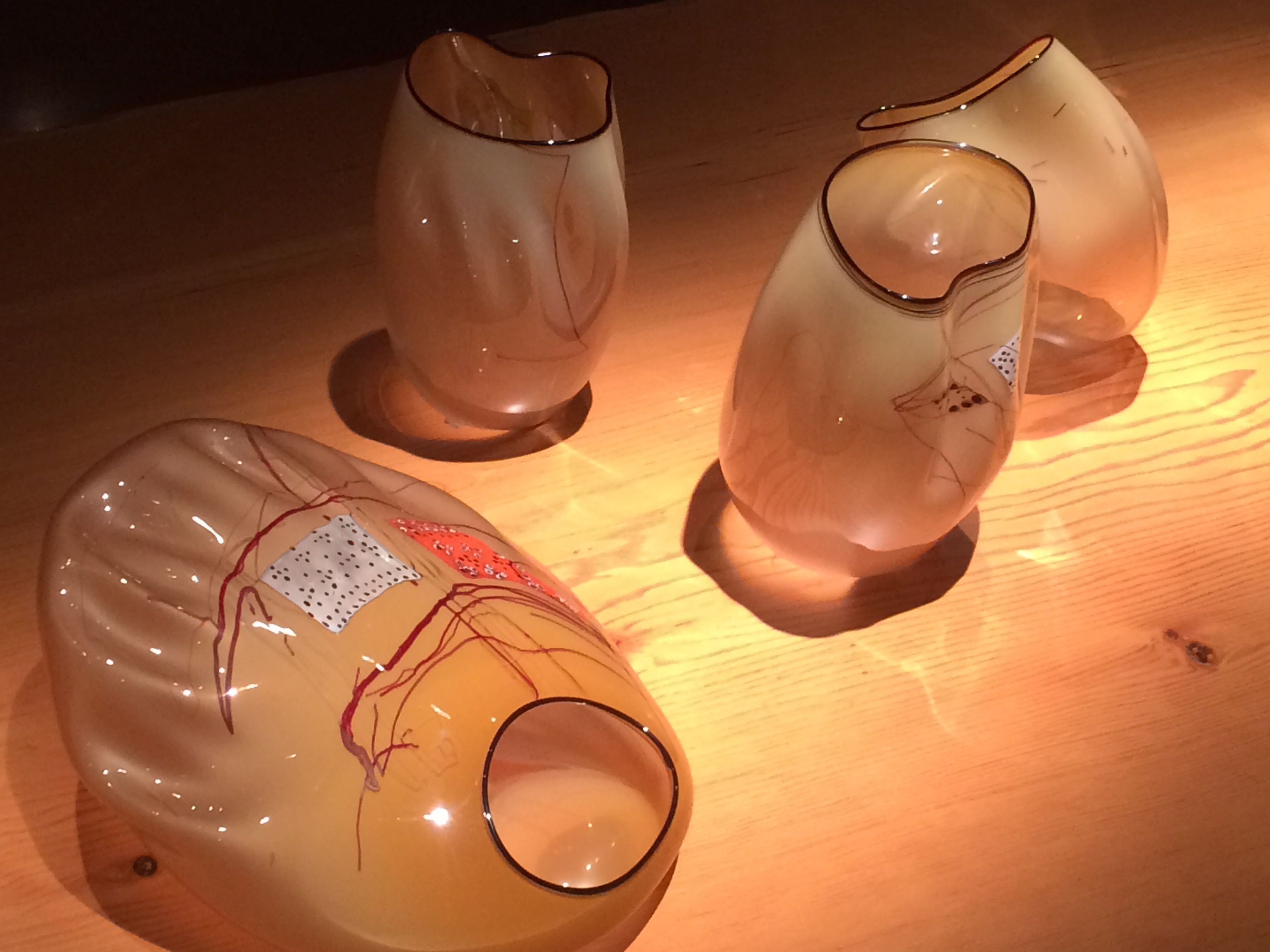
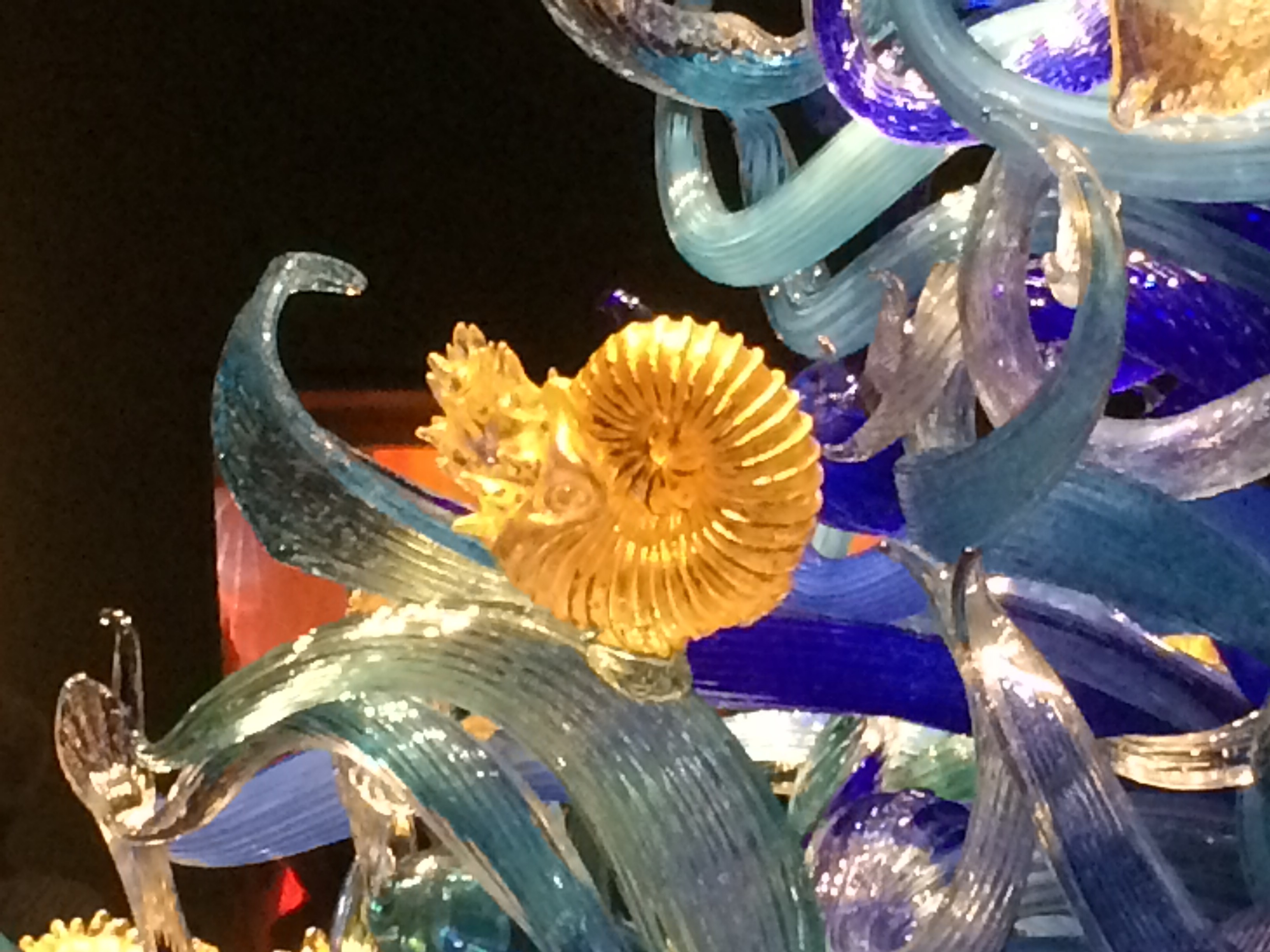
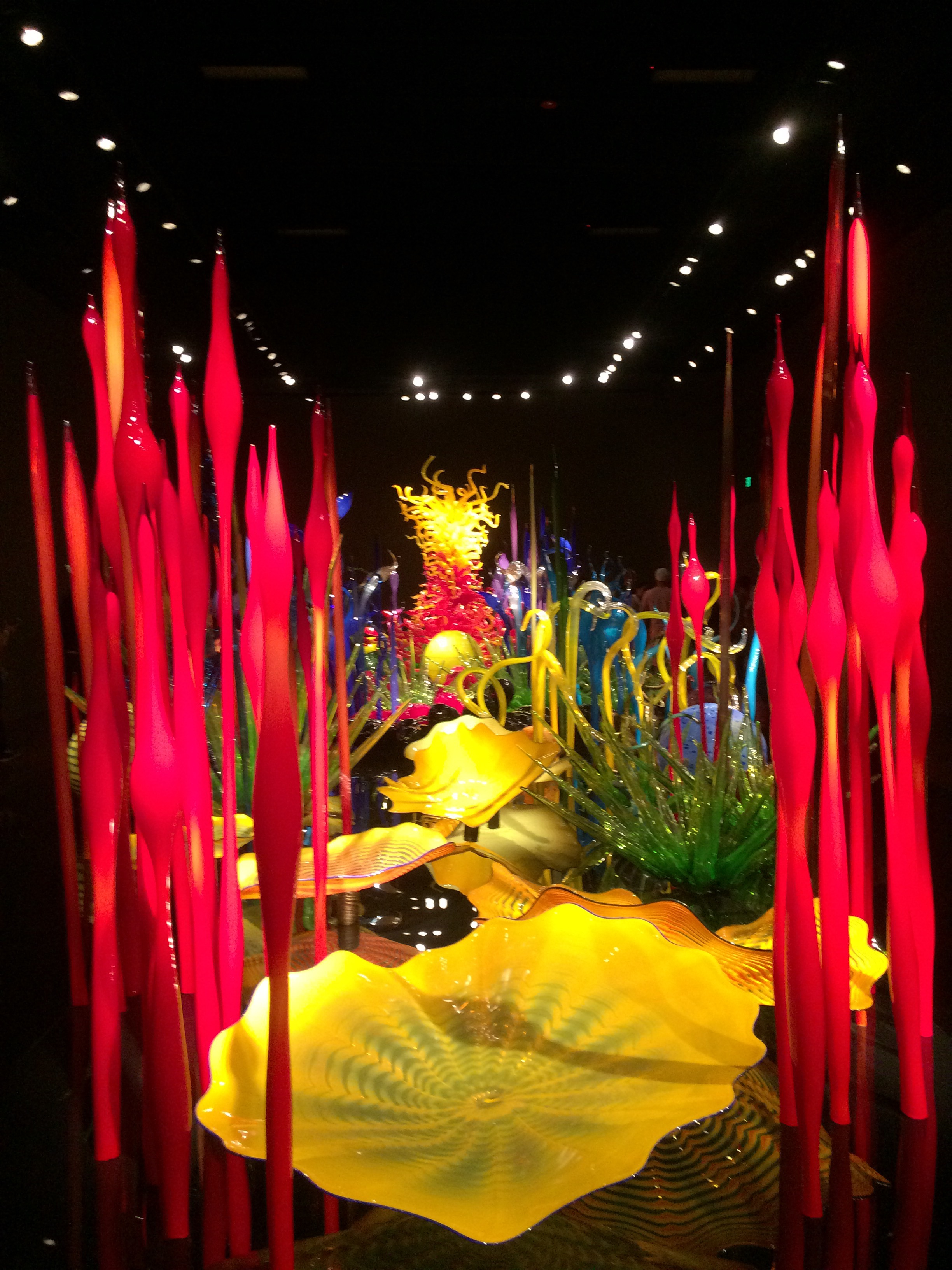
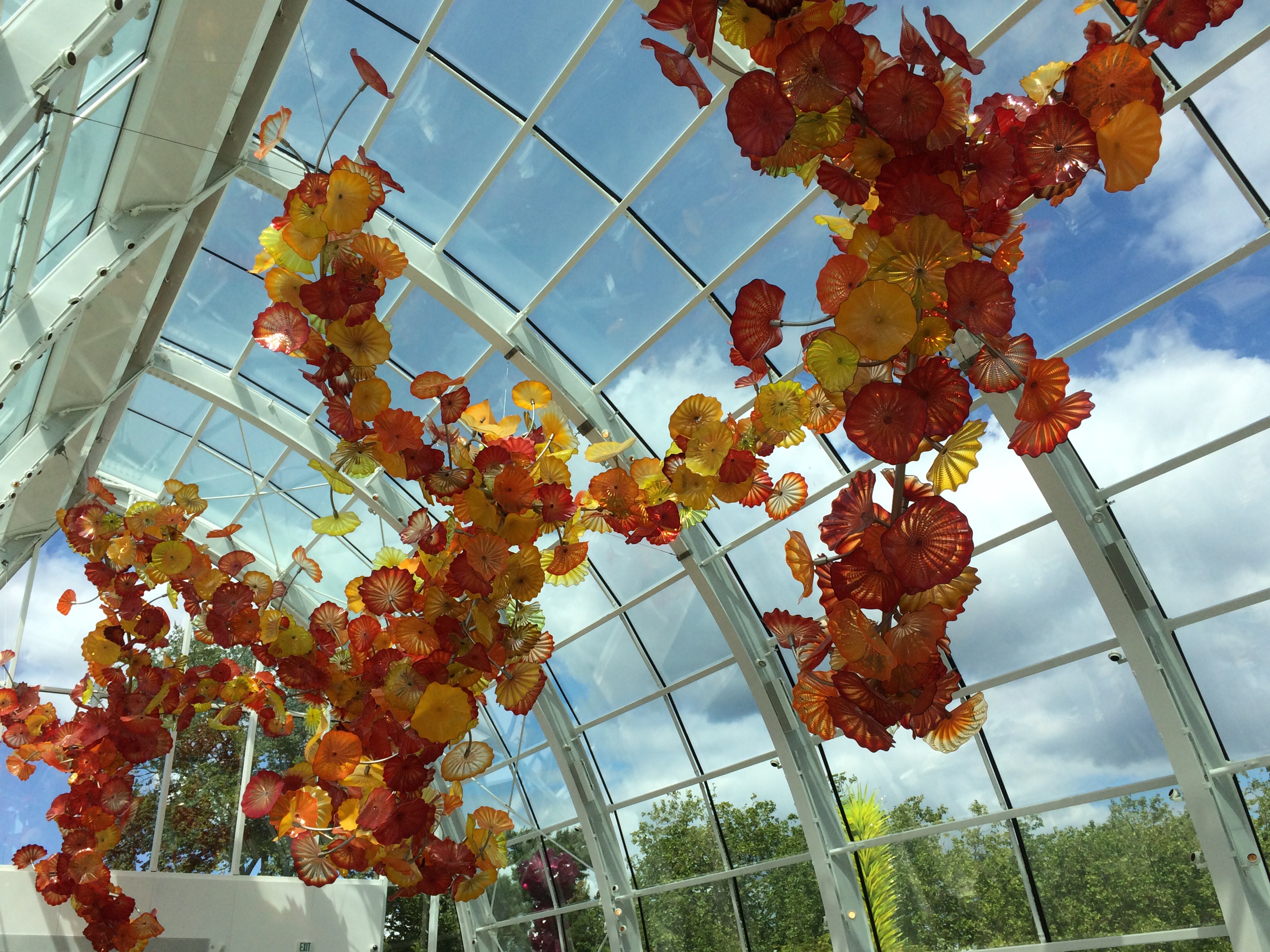
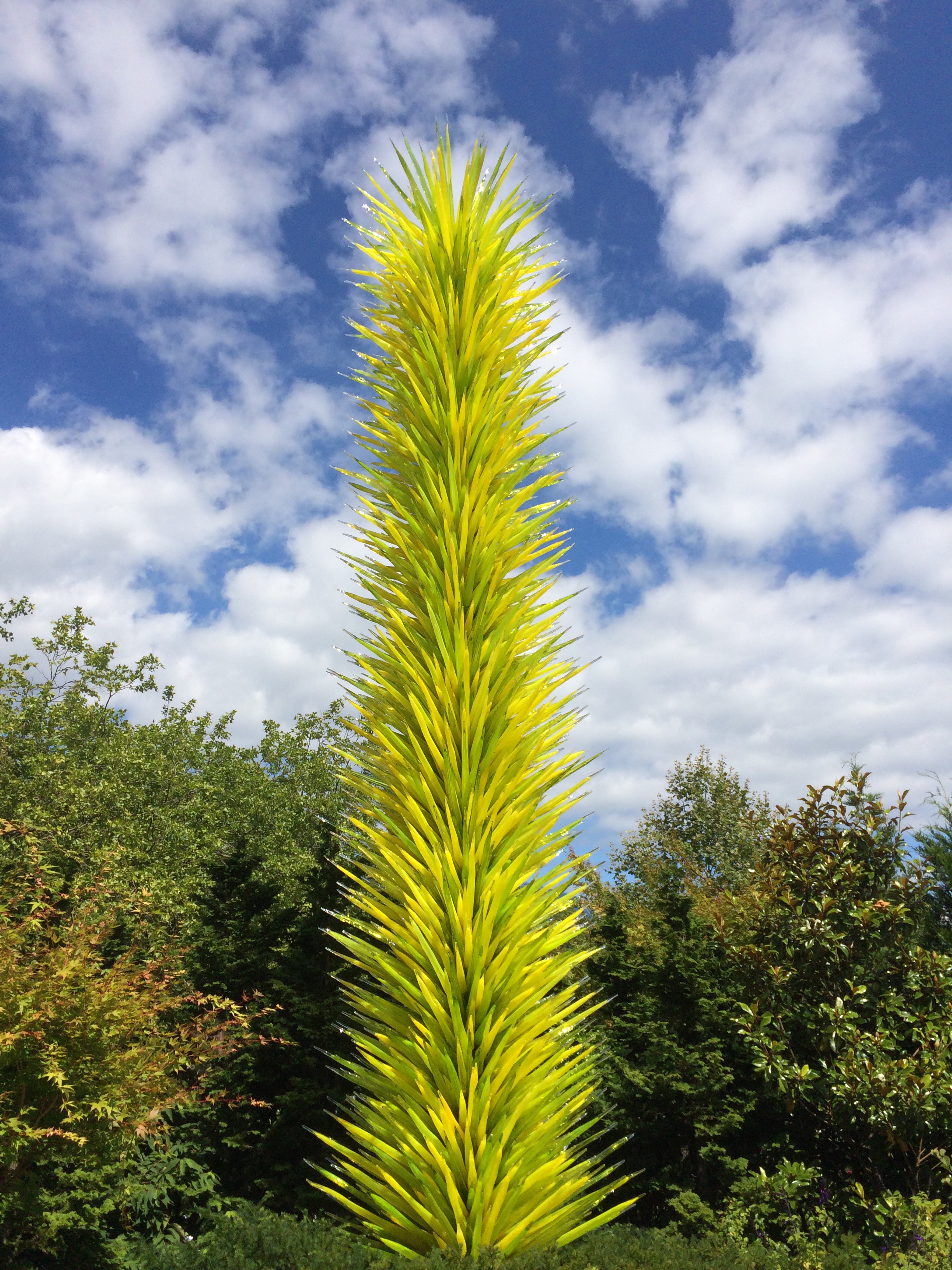
Even though the Chilhuly Garden and Glass in Seattle Center at the base of the Space Needle provides a lot of information about the hard work and the collaborative process behind Chihuly’s remarkable glass creations, there is still an element of magic in each of his pieces that is uniquely Chihuly. His skill in his medium, his incredible use of color, and the imaginative and fantastic portrayal of simple things like fish, flowers, and amorphous shapes are all elements of the stunning work he does. In eight galleries, three drawing walls, and magical garden, his pieces amaze, amuse, and sometimes awe. Below are just a few examples of Chihuly’s works that were part of our Saturday in Seattle:
Category Archives: 2016 Western Travels
Driving Through the Bottom of a Floodplain
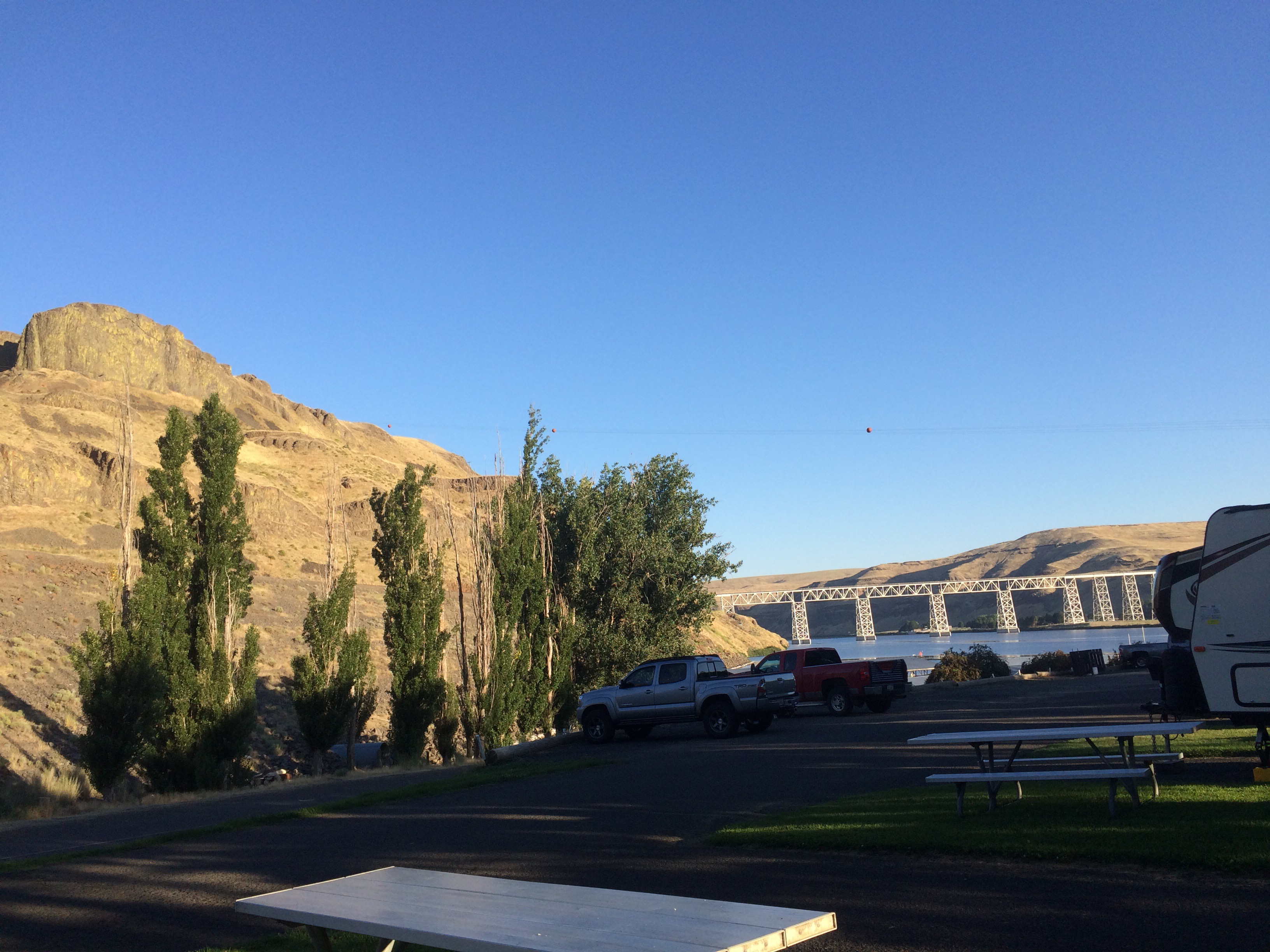
Thursday morning, July 24, found us camped on the banks of the Snake River surrounded by the hills of Eastern Washington, one of the most scenic campsites we’ve ever stayed at.
Our destination was Seattle, to spend a long weekend with family, but first we wanted to see Palouse Falls, just a few miles away. The Palouse Falls are over 1,000 feet high and, along with the canyons beyond it, are part of the channeled scablands formed by the Great Missoula Flood, a series of glacial freezes and thaws that periodically flooded the plains of Montana, Idaho, Washington and Oregon covering the land with water that left its mark on the canyon walls. A map of this flooding shows where Palouse Falls sits in relation to the flooding.

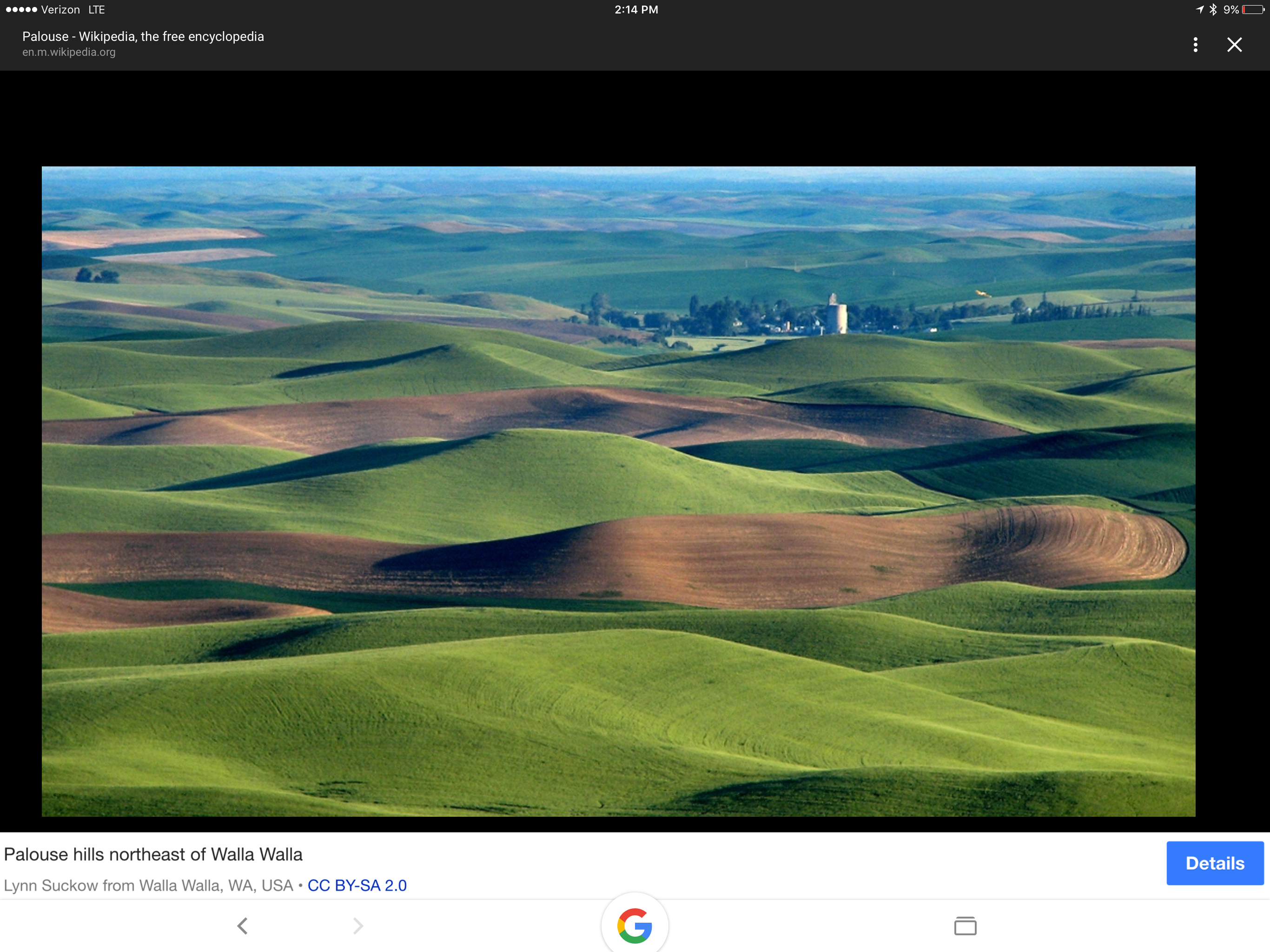
As we were headed for Seattle, much of our drive took us through land that had at one time been covered by water, and when viewed from that perspective, much of the land formations and valleys carved with ridges and channels (former sandbars?) make sense. The picture below (thank you, Wikipedia!) illustrates this far better than any of mine.

Awesome Yellowstone
I’ve been to Yellowstone four times, and I have thus far seen only about a third of it. It is awesome on so many fronts: its mountains, rivers and valleys make every turn in the road a photographical moment; and of course, its geysers create both sporadic and quasi-predictable memorable events. Yellowstone takes great pride in its status as the first National Park, and it has set a very high standard for all the others to follow.
What do Mount Rushmore and Crazyhorse Have In Common?
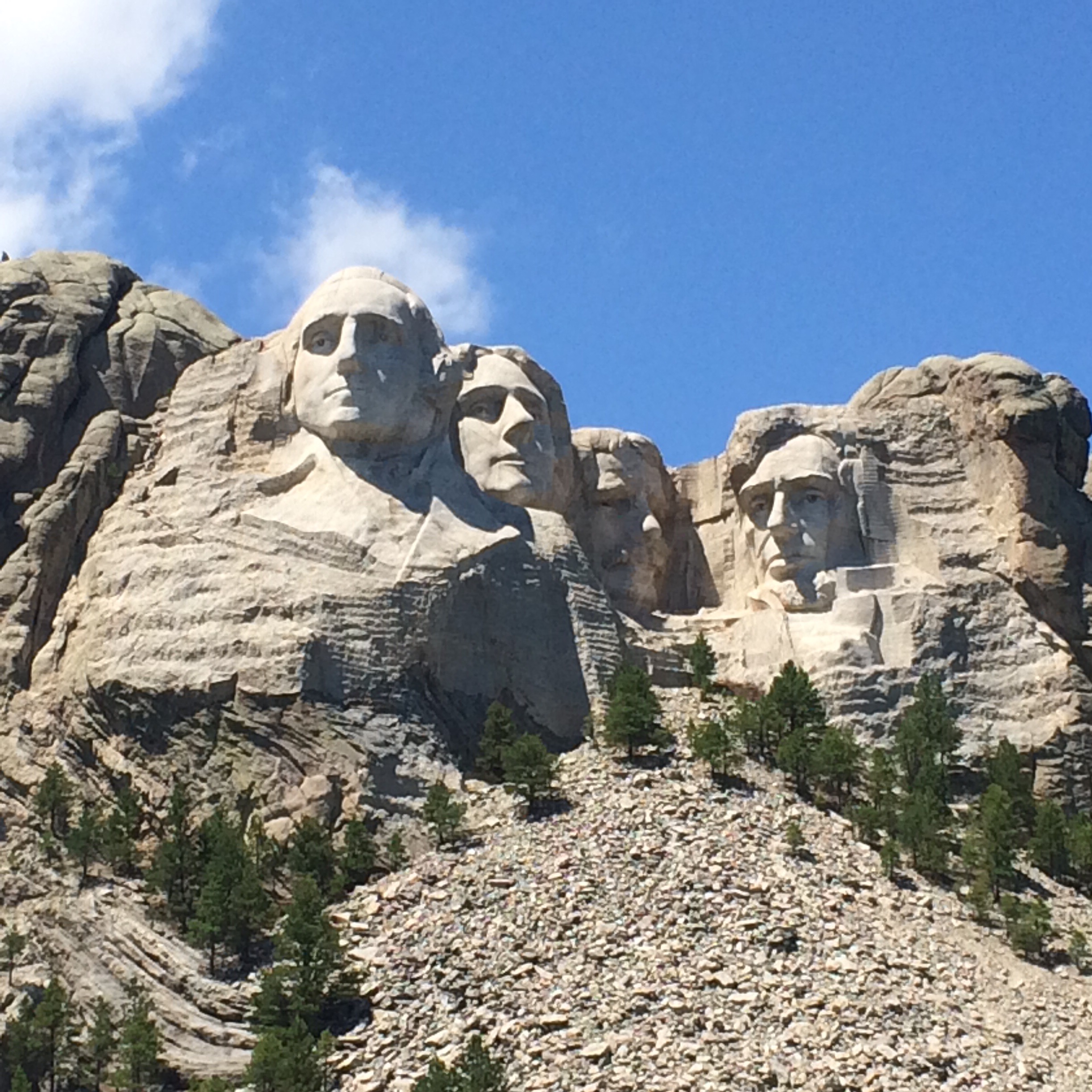
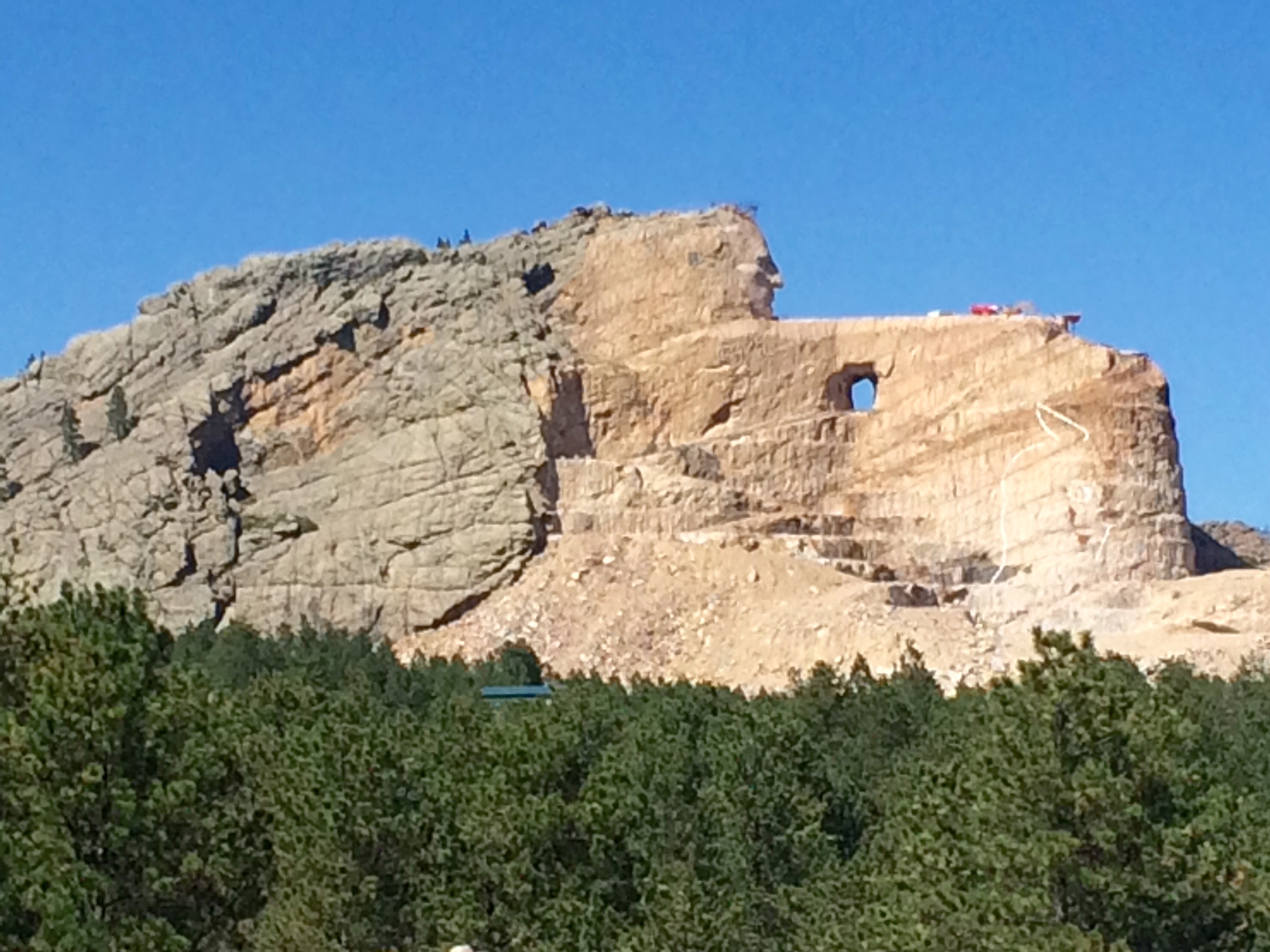
Two men with an immense imagination and a capacity for work. The two monuments, while commemorating the nation’s founding fathers and a Native American who cared deeply for his own Indian nation, atruly the story of Gutzon Borglum and Korczak Ziolkowski.
Borglum was an American sculptor who started life in a polygamous Mormon family, apprenticed as a machinist, but then went to Paris to study art where he met and was influenced by Rodin. He was fascinated by gigantic scale and themes of heroic nationalism and was initially involved with the carvings of Stone Mountain. One of of his earliest works was a head of Abraham Lincoln carved from a six-ton block of marble. He was a natural choice when South Dakota state historian Doane Robinson began the Mount Rushmore project. Originally, it was only to include Washington and Jefferson, later expanded to include Roosevelt and Lincoln. Borglum didn’t live to see the project completed; he died from complications of surgery about a year before it was completed by his son, Lincoln Borglum, and even then, Roosevelt and Lincoln were both relatively unfinished.
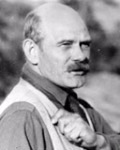
Korczak Ziolkowski came from a very different background. He had worked on Mount Rushmore with Borglum and had learned the important skills necessary for sculpting on an immense scale, in particular the ability to control explosives. He was contacted by Lakota Chief Henry Standing Bear to create a monument to Crazyhorse who was an important leader of the Oglala Lakota and a man that the Native Americans viewed as a hero. In the monument he is depicted as a warrior on horseback pointing to the hills where his people are buried. Ziolkowski also did not live to see the completion of his project, but he left behind his wife and ten children, the majority of whom are still involved with the completion of the project, and also the foundation which Ziolkowski and his wife created to support the project. Only private funds raised by the Ziolkowski’s have been used for this project, and they are adamant that no Federal funds will be involved. In addition to the monument, the foundation is also involved with the creation of a Native American university on the land beneath the monument which will someday have a medical school.
I have always been awed by what one person can achieve in this world if they focus all their energy and effort to making it happen. While both of these monuments required many thousands of workers, it could only have been conceived through the imagination of sculptors capable of dreaming beyond the scope of most people’s imaginations.
National Music Museum
Vermilion is a charming university town that is home to the University of South Dakota, and within the university the National Music Museum, housed in a former Carnegie Library on campus.


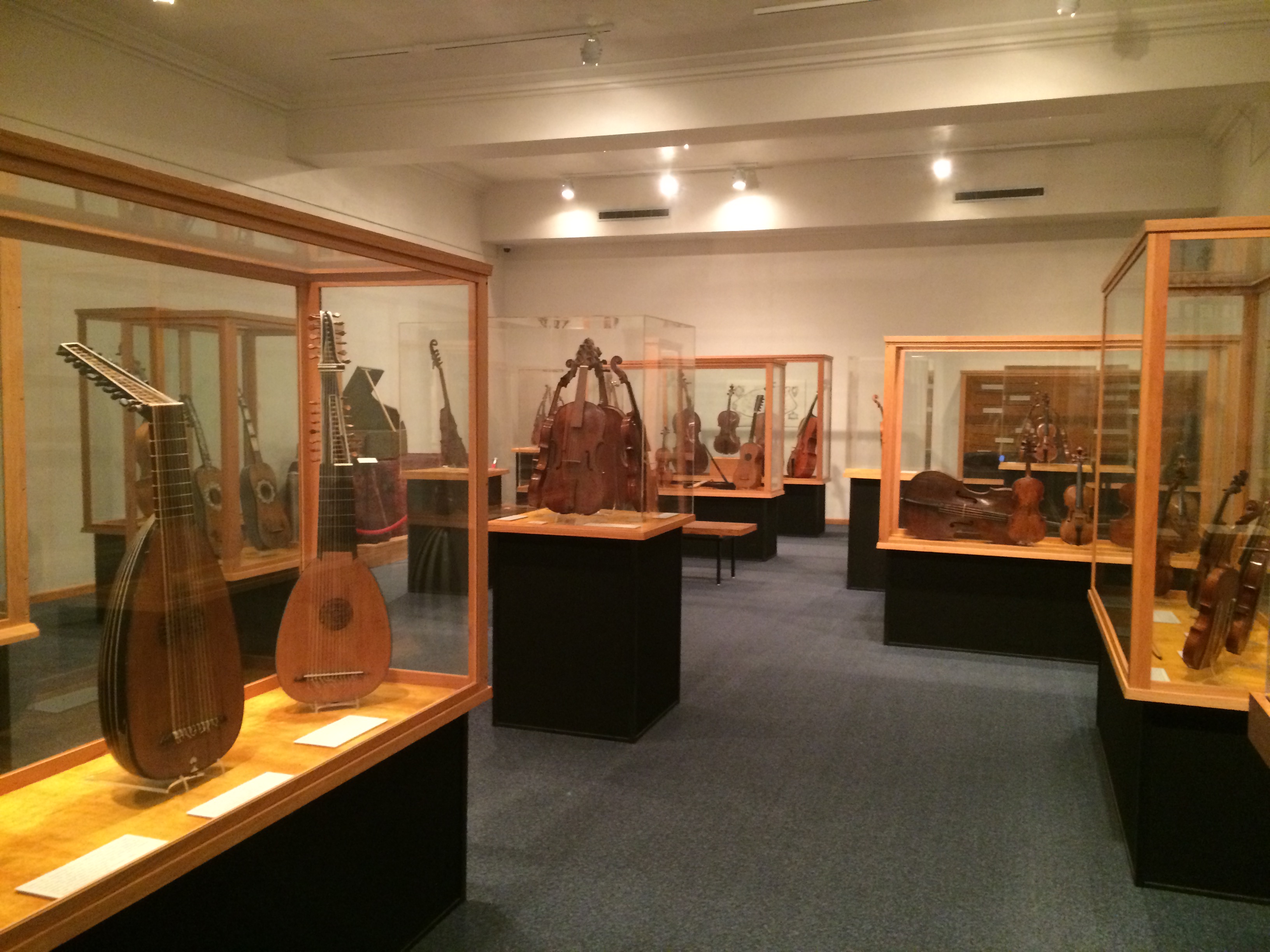
The collection is extensive, a superb collection of all types of instruments from original string instruments made by the masters of the 16th century up to the present day. An audio tour of the collection gave you both a description of the instrument you were viewing and a sample of the sound made by that instrument. For example…
This early 19th century piano is the kind that Beethoven or Schubert would have played. The beautiful painted design above the keys also extends to the bottom of the cover.
This beautiful 18th century organ was donated by one of the local churches; it is actually a reed organ but is decorated with a facade of pipes, as they were a much more costly instrument.
A roomful of stringed instruments from all of the most noted luthiers over the centuries could have have kept us there for hours more than we had time to spend a that NMM.
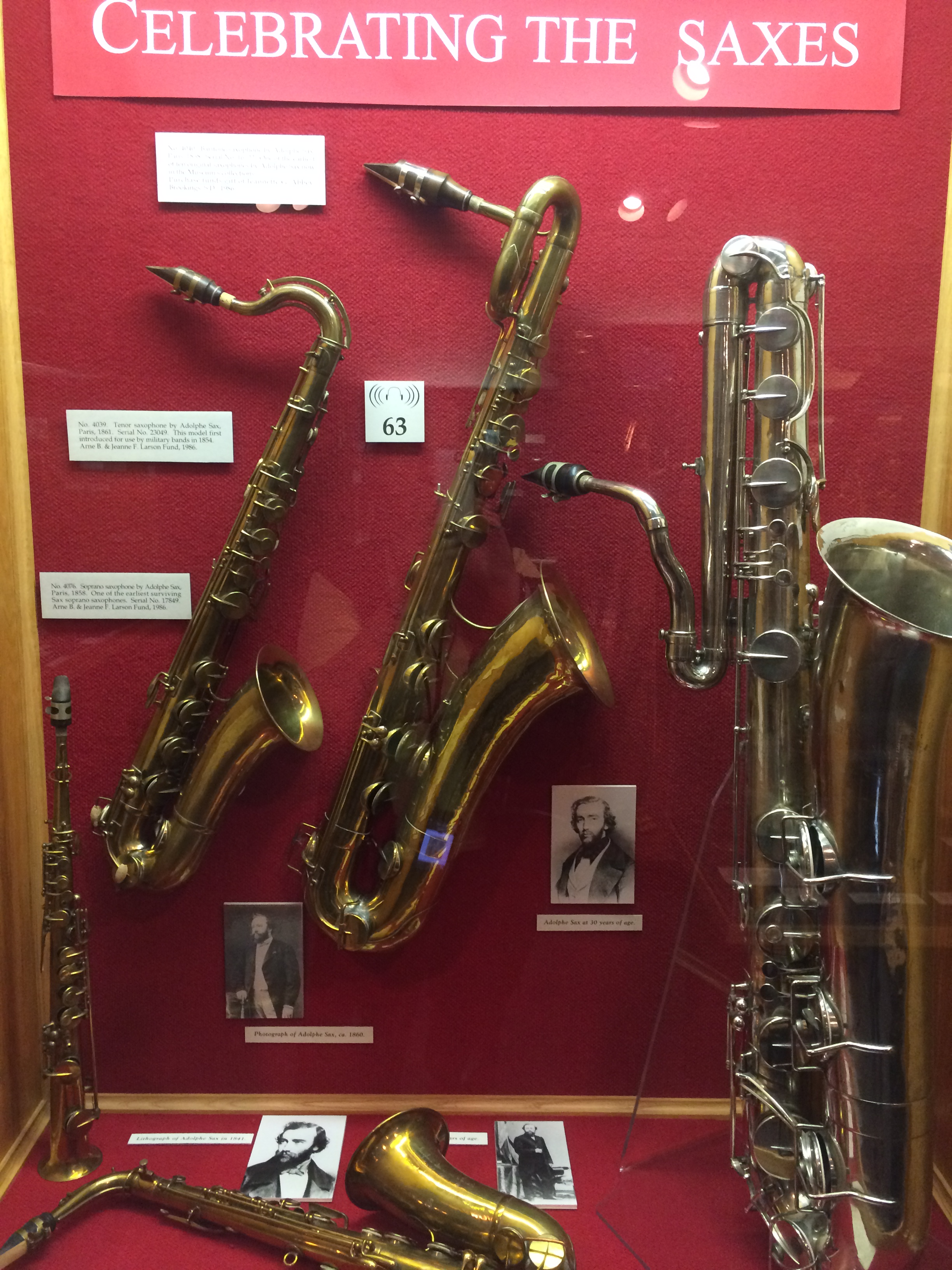
Adolph Sax, inventor of the saxophone, was a prolific inventor and instrument-maker, His instruments filled this cabinet and another (not shown).
The National Music Museum was started when a South Dakota bandleader and enthusiastic collector of musical instruments, Arne B. Larson, needed a home for the more than 2500 instruments he had collected. Since then the collection has grown to about 15,000 with donations and purchases. When generous donor gave $3 million dollars to acquire the collection of early Italian strings pictured above, it put NMM “on the map,” up there with some of the fine collections in the Metropolitan Museum of Art and the Musical Instrument Museum in Phoenix.
It was a glorious way to spend Saturday morning, and we could have easily stayed all day. Instead, we headed west to make it to Belvidere, SD to be in a good location to visit next Mount Rushmore and the Crazyhorse Monument.
National Sprint Car Hall of Fame and Museum
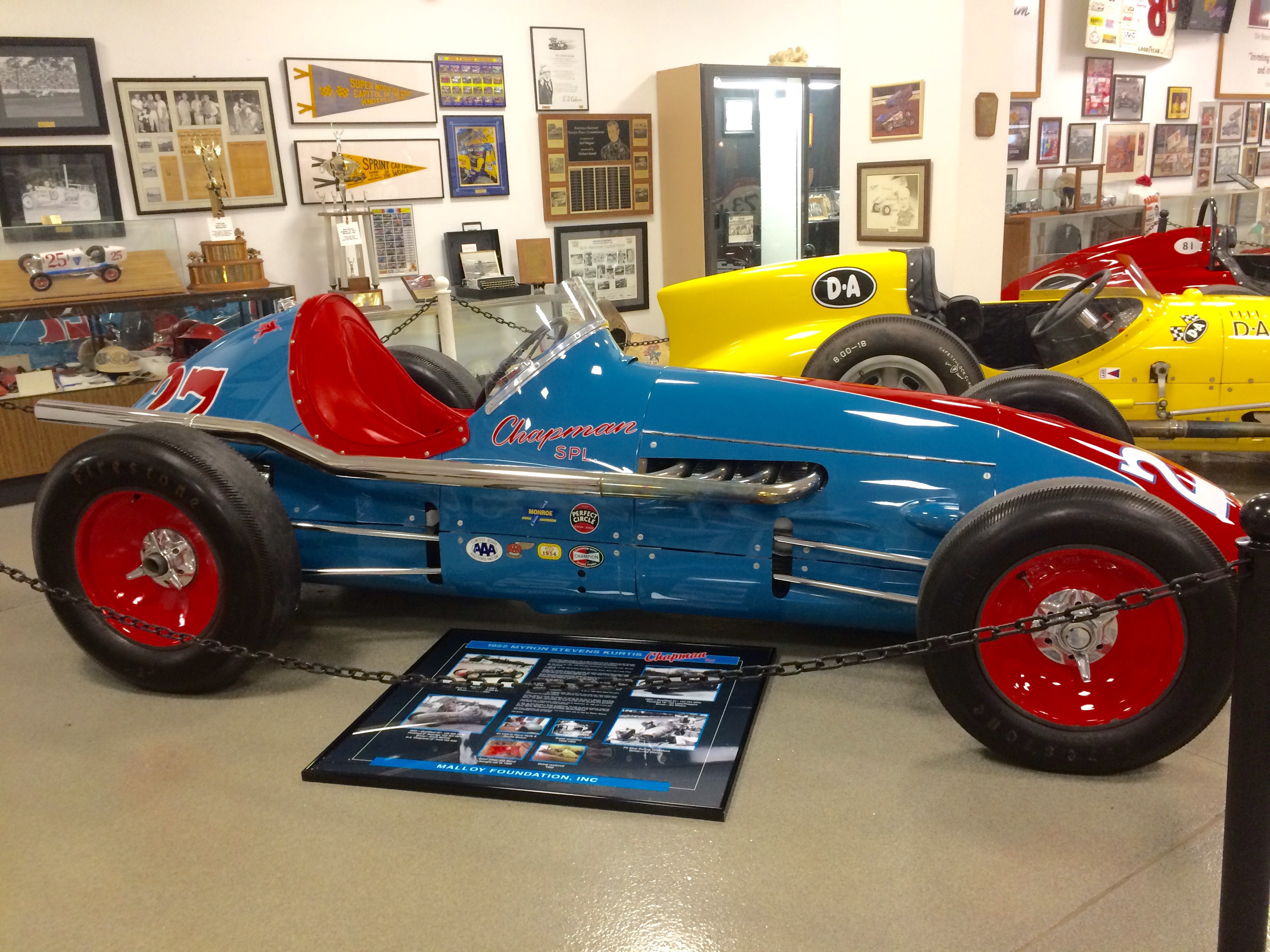
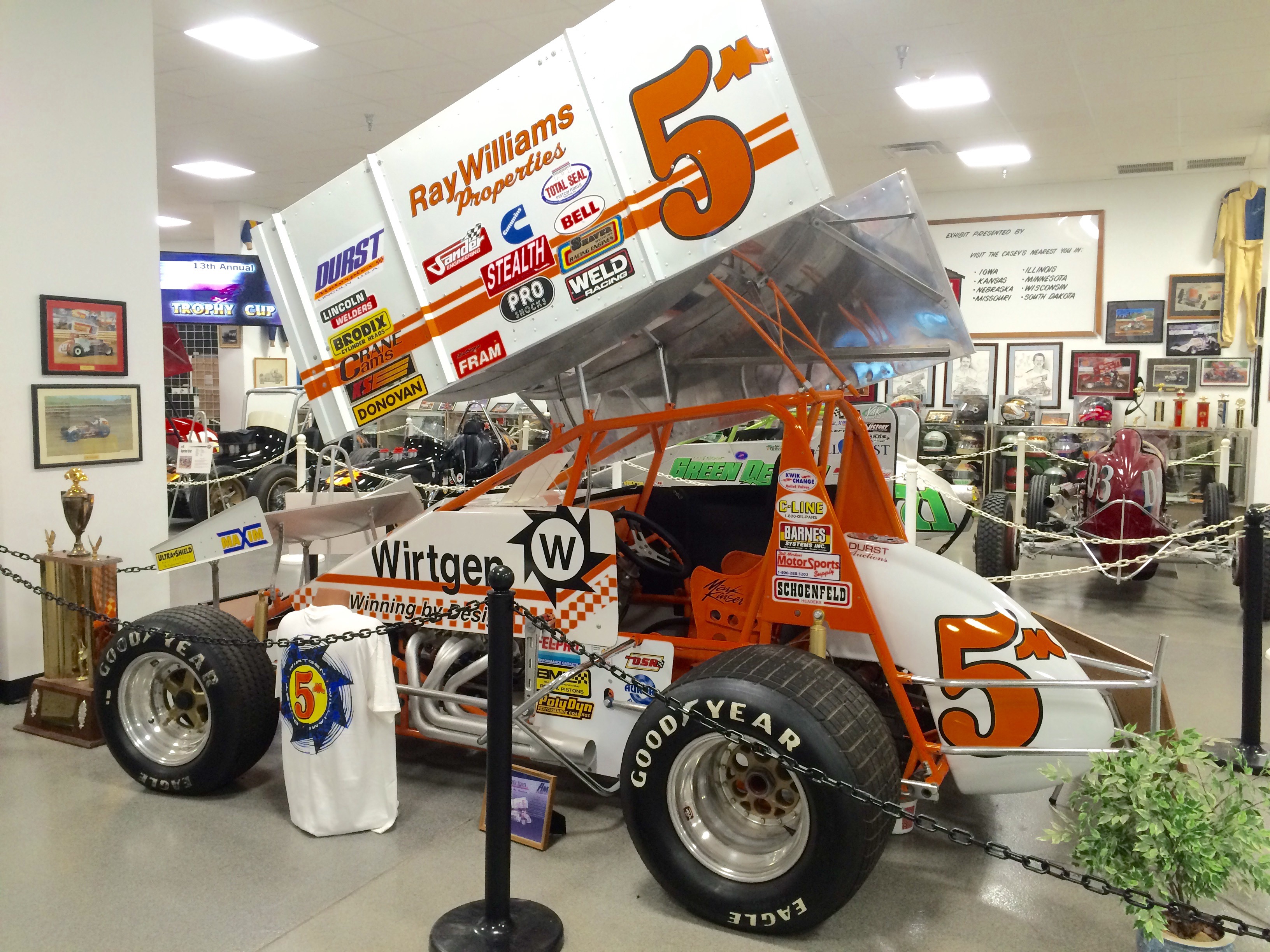
In Knoxville, a small museum has a superb collection of “sprint cars”, which are different from the “stock cars” that are see in the more popular NASCAR races. Those cars are based on cars provided by Ford, Chevy, or Toyota. Sprint cars are built from scratch, sometimes by their drivers, and the race course is a dirt track rather than the paved racetracks that NASCAR races require. Racing on such a course calls literally sliding sideways around many of the curves, always with the possibility of spinning out. It’s a dangerous sport and one found predominantly in the Midwest.

Some of the first sprint cars looked like the blue one below, built in the early 1950’s. In later years, this original design was significantly altered by the addition of “wings” which were used to manipulate the air passing over the car to improve its performance, like the red and white car below.

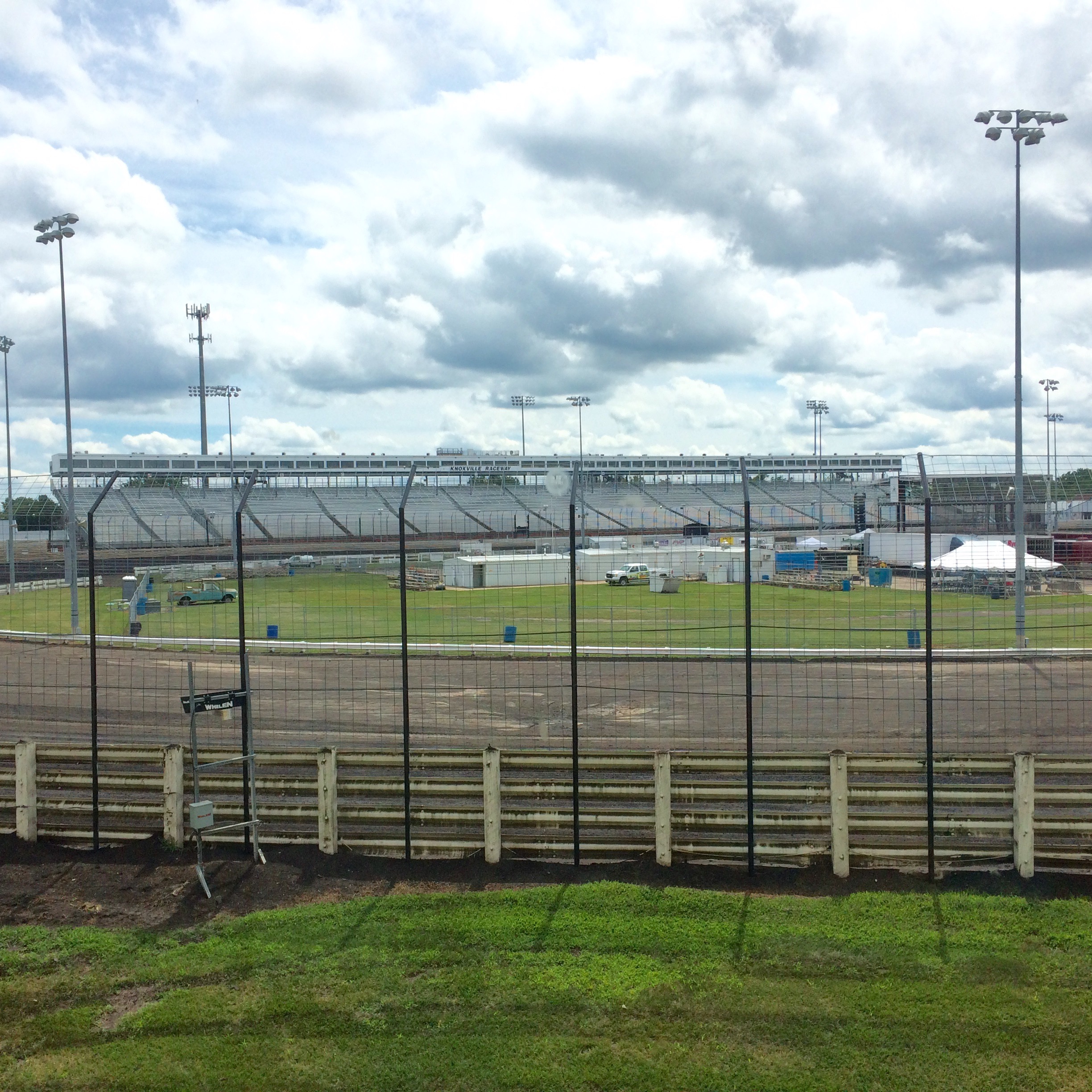
The racetrack is built from local Iowa loam, which becomes like fly-paper when it’s prepped with water, to the extent that if you walk on it with sandals it will suck them off your feet. The track was being prepared for a race the following day, and the water trucks were steadily watering the track as we watched.

In the Hall of Fame section of the museum, some of the winners license plates were arranged to decorate one of the walls in an unusual and appealing manner.

The remainder of the day was spent traveling to western Iowa to be in a good location to reach Vermilion, South Dakota the following morning to tour the National Music Museum at the University of South Dakota. And at last we left behind the humidity of the high temperatures of the East and slept well in cooler, drier night-time breezes.
Who Was Born in Grant’s Birthplace?
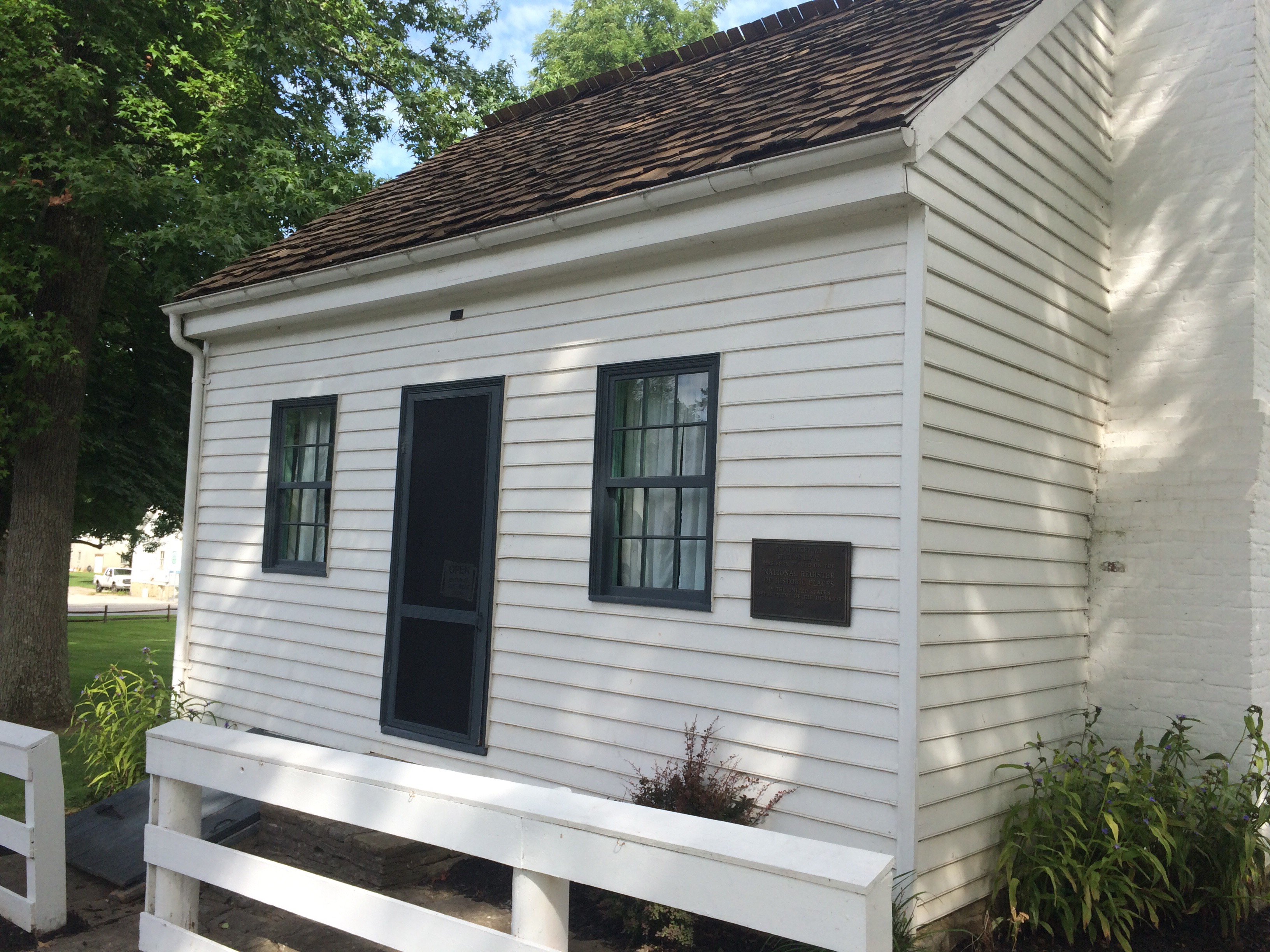
The immense community pride that the small town of Point Pleasant, Ohio has for Ulysses S. Grant is very evident in the way they continue to honor their native son. While he was born here, the Grant Family lived here only a short time before moving to Georgetown, Ohio; nevertheless he is the main attraction is this charming town. Ulysses grew up in a family of tanners, and but for a favor to a friend of his fathers, he would not have become a West Point cadet and ultimately a three-star general, a rank previously held only by George Washington. His humble beginnings are very evident in this one room house.
The house shown above became a tourist attraction in Point Pleasant a short time after Grant’s death, but when it failed to bring in the tourists needed to make it a profitable attraction, the owner literally took it on the road, or rather on the river. He moved it onto a barge and took it as a traveling tourist attraction down the Ohio River to the other port cities. When he reached the southern end of the river, he was unable to put it on a train to tour the inland cities, so he took it apart, numbered each piece, and traveled with it to state fairs and other well-populated venues, re-erecting it in each new site with the help of local men. Finally it returned to Point Pleasant, was adopted and nurtured by a local group of citizens, and today it stands, painted and polished up, and staffed by a very knowledgable guide.
“Of all the U.S. Grant homes and national sites,” he states proudly, “ours is the only one to have a baby picture of U.S. Grant.” Eyes are directed to the baby crib next to the rope-strung bed covered with a quilt made by a local group of women; see below.
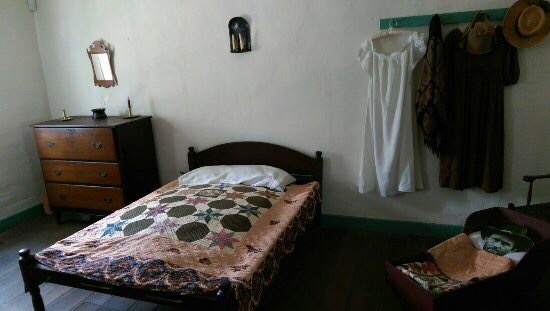
“That get’s a laugh every time,” he chuckles, and proceeds to give us a very personal and insightful tour of the house’s artifacts. The most interesting one was a clever piece of furniture I’ve never seen before, a nanny’s rocker. Built to hold both the nanny or mother and the child behind a removable front enclosure, it clearly was intended to help the woman continue to be productive while the child she was guarding could be comforted with a gentle rocking. It was an original piece belonging to Grant’s parents.
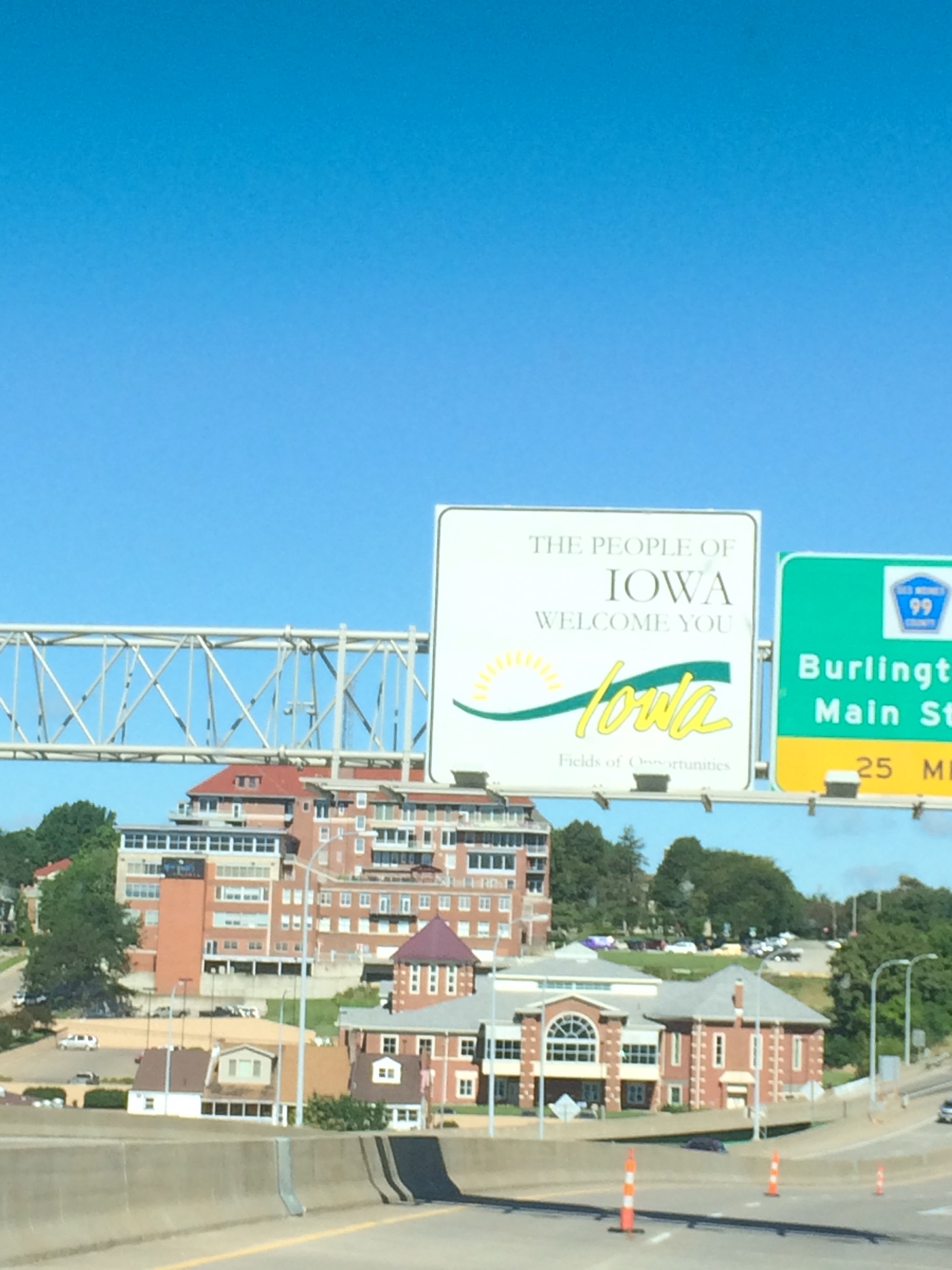
The remainder of our day was spent traveling into Iowa where we spent a quiet night in a campground outside of East Knoxville, Illinois. Crossing into Iowa at Burlington, I experienced once again that awe that only a river as grand as the Mississippi can inspire.
Katrina Revisited
Never before have we started a vacation by visiting a site of one of the worst natural tragedies in recent history. Route 60 took us through the town of Rainelle, West Virginia, a town that was devastated in the 2016 West Virginia flood that began with torrential rains on June 23. Thunderstorms poured up to 10 inches in just a few hours that then produced widespread and destructive flash flooding. One of the citizens was quoted as saying “Many people lost everything and some people lost their lives….This is our Katrina.”
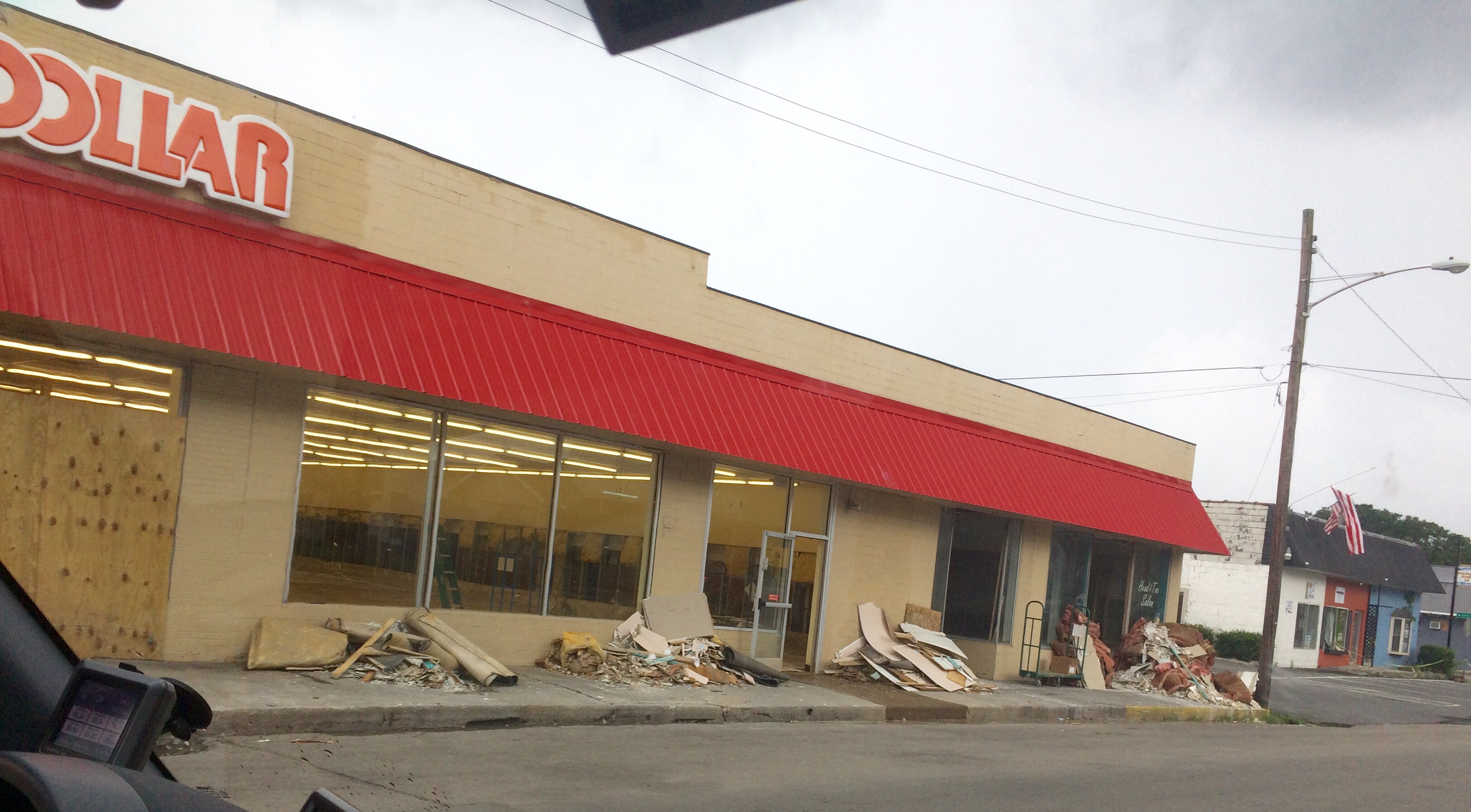
We first noticed huge piles of trash in front of nearly every home and business. Then we saw the Red Cross signs for help. A fellow I met at the Subway several towns further down the road told me they had opened their schools and town hall for the families who were evacuated, and some were still living in shelters.
Imagine the picture above times several hundred. In a town of 1500 population, losing one person is a tragedy; Greenbrier County, in which Rainelle is found, lost 15 lives. It was reminiscent of the trip we took through Louisiana and passed through New Orleans one year after Katrina. Huge piles of debris still filled the center of the roads and the empty lots. Rarely do we see so clearly this lesson that our lives and homes are so very fragile.
The remainder of the day was spent wandering through the mountains of West Virginia into Kentucky, and finally reaching the relatively flat plains of the farmlands of Western Kentucky and eastern Ohio. Corn and soybean crops all looked healthy. We spent the night on a lovely (and lonely–we were the only campers there!) campground on the Ohio River. This was our view that afforded a lovely sunset.
Away Out West
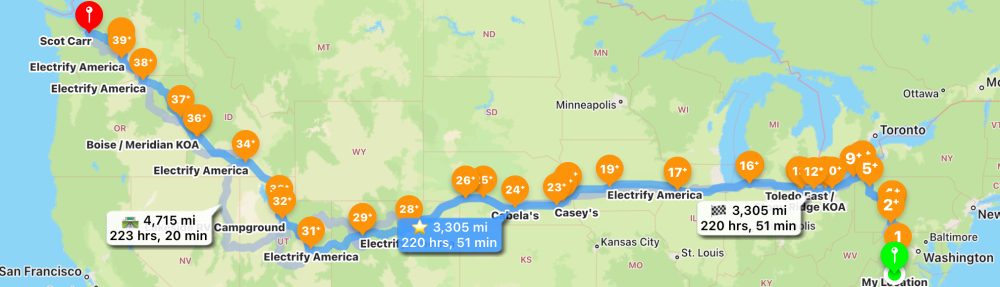
Tomorrow we hit the road, once again heading west to connect with our West Coast family. Having done this so many times, we’re challenged to find a new route to get from Virginia to Washington. This year will be our first time taking a diagonal route across the U.S. Tomorrow we head towards West Virginia, and follow a number of non-interstate routes through Ohio, Indiana, Iowa, and Nebraska. Then we’ll cut through corners of South Dakota and Wyoming on our way to Montana, Idaho, and ultimately ending in Seattle, Washington. The total trip should take about 8 days. First stop, Stout, Ohio, notable because its official name is Rome, after the city in Italy, but it was originally laid out by William Stout, which the community and even the US Postal Service uses as its name. Population in 2010 was 94, having started in 1870 with 471 and steadily shrinking since then.
.